Real-time Observation for Adaptive management in southeastern oaK forestS (ROAKS)
Senior Researcher dr. eng. Ștefan LECA
PROJECT DIRECTOR
About the project
The ROAKS project develops an integrated monitoring system to assess how Romanian oak forests respond to climate change by measuring air, water, soil, and tree interactions (AWST Nexus).
Combining field measurements, sensor networks, and remote sensing data, the project enables near-real-time detection of forest stress and supports adaptive forest management. Its results contribute to the Europe-wide ForestWard Observatory, strengthening long-term forest monitoring and resilience strategies.
Project objectives:
O1: Enhance the ROAKS network in Central Eastern Europe, with a focus on oak ecosystems and the AWST-Nexus, integrating it into existing or developing international networks to foster strengthened collaboration, knowledge exchange, and adaptive ecosystem management;
O2: Apply AWST-Nexus by conducting field measurements (FM) and remote sensing (RS) and expanding to supporting sites for ensuring spatial representativeness;
O3: Ensure long-term monitoring data in near real-time and stress nowcasting for the ForestWard Observatory.
Project activities:
The ROAKS project aims to enhance the understanding of climate change impacts on Central Eastern European oak forests. By integrating advanced monitoring techniques, the project will assess oak tree responses to stressors such as drought, pests or insect disturbances. The research will be conducted in two key ICP Forests oak plots and four supporting sites, providing insights into forest resilience and contributing to the ForestWard Observatory initiative. The objectives include enhancing the ROAKS network, applying the Air-Water-Soil-Tree (AWST) Nexus through field measurements and remote sensing, and ensuring long-term monitoring data in near real-time. By involving fieldwork in diverse climate conditions, ROAKS will enhance our understanding of climate impacts on forests. The integration of the AWST Nexus into the existing ICP Forests system will create new research opportunities for European forest monitoring, supporting adaptive management strategies and contributing to the long-term conservation of European forests. By using remote sensing technologies and standardized methodologies, ROAKS will provide temporally dense information on soil moisture, tree ecophysiological responses, and carbon storage. The project will also facilitate collaboration and knowledge exchange within international networks, enhancing the scalability and representativeness of the findings.
Infrastructure and research services
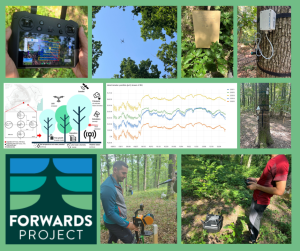
The ROAKS project will address spatial design in a way that ensures both representativeness and scalability. The project will utilize two “candidate supersites” (Level II ICP Forests & LTER sites “Mihaesti – Gorun” and “Stefanesti – Stejar”) (see diagram). These plots are strategically chosen to represent two different climatic regions: Mihaesti-Gorun (sessile oak plot) represents Dfb climate type (cold, no dry season, warm summer) and Stefanesti-Stejar (English oak plot) Dfa climate type (cold, no dry season, hot summer), according to the Köppen-Geiger classification. Although the candidate supersites are classified within the same, continental bioregion, Mihaesti-Gorun is situated close to the alpine bioregion and Stefanesti-Stejar near the steppe bioregion. This ensures that the data collected reflects the range of oak ecosystems in the region. Beyond the S, supporting sites will be established, encompassing 4 already existing monitoring plots with similar soil and forest types and environmental conditions. The first two SS are placed near Stefanesti plot (one from an existing INCDS research network at 1 km and the second one at 7 km in an ICP Level 1 plot) and latter ones are placed near Mihaești (two new research plots, one located one kilometer away, and the other approximately 10 kilometers away from S, in INCDS forest research area) These sites, will provide a broader spatial context and allow for the investigation of regional variations in oak forest responses to environmental stressors. By combining intensive monitoring at the supersites with supporting measurements at the supporting sites, ROAKS will capture both detailed, localized information and broader, regional trends. This multi-scale approach enhances the representativeness of the findings and facilitate a more comprehensive understanding of oak forest dynamics. The project will employ the AWST Nexus (Air-Water-Soil-Tree Nexus), and a standardized methodology (i.e. ICP methodology) for collecting meteorological, soil, and tree-related parameters, close-to-real-time (see the above diagram). During the project, we will provide a consistent and scalable approach to data collection, enabling comparisons across different sites and facilitating upscaling of findings within the continental biogeographical region, where Quercus species serve as representative keystone taxa that have been significantly affected by increasing drought conditions over the past decade. ROAKS will leverage remote sensing technologies, including Terrestrial Laser Scanning (TLS), drones, and satellite imagery, to scale up observations from the ground plots to larger areas. This allows for the extrapolation of findings from the intensively monitored supersites to the wider landscape, enhancing the scalability of the research. Considering the different designs of the selected plots for structural assessments of forests in supporting sites, we will apply the same plot design as in supersites (a cross cluster of five 500 m² circular plots). In this way, we will enhance the scalability of our results.
Funding
The ROAKS Project is funded under Grant Agreement 101084481 — FORWARDS — HORIZON-CL6-2022-CLIMATE-01 between EFI and the Research Executive Agency (REA) (‘the granting authority), under the powers delegated by the European Commission.
Contact
E-mail: stefan.leca@icas.ro